
When a Student Presses That Button… Will It Work? The Hidden Risk Behind Code Blue Emergency Phones
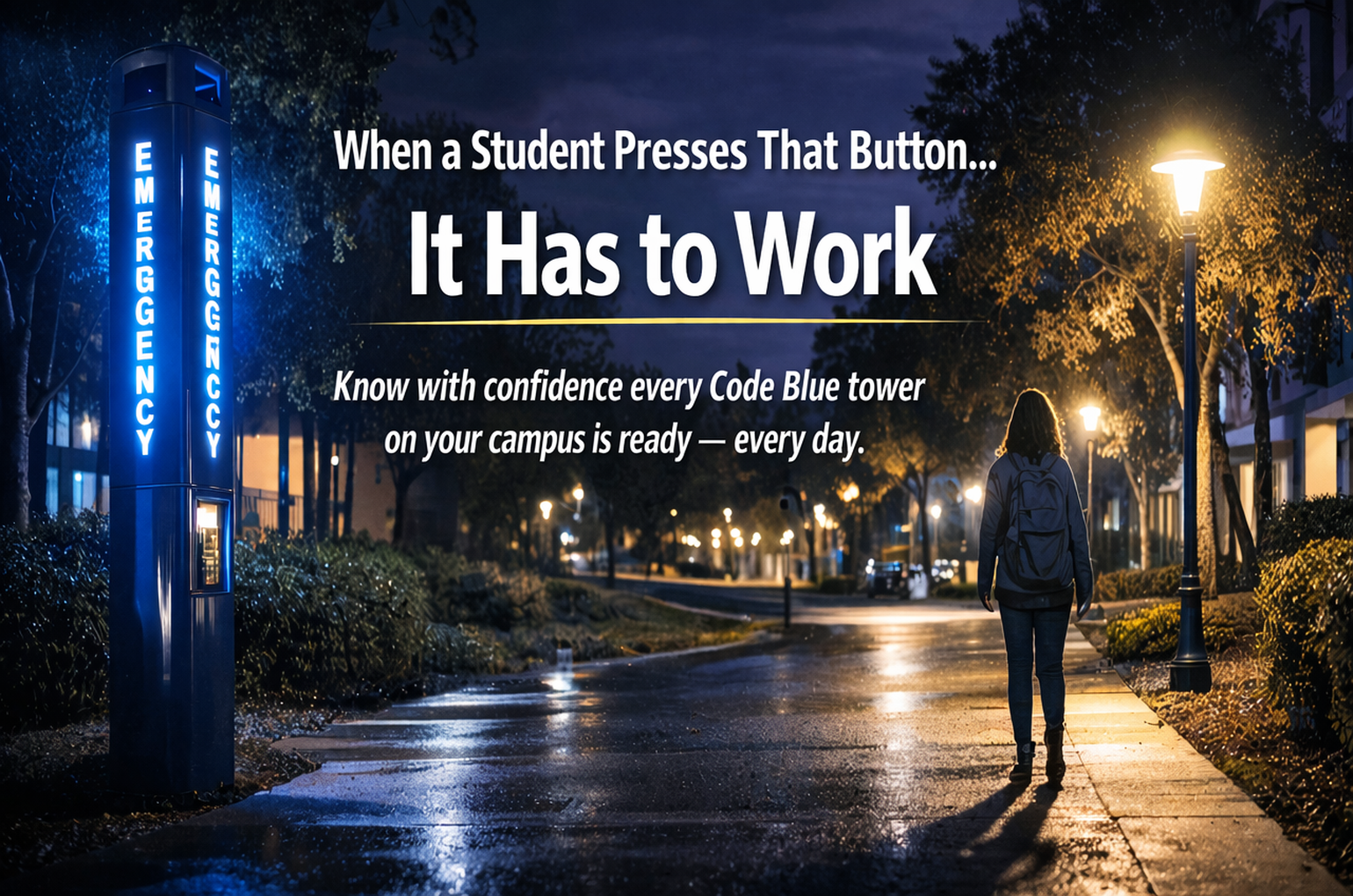
When a Student Presses That Button… Will It Work?
The Hidden Risk Behind Code Blue Emergency Phones
Walk any campus, and you’ll see them.
Tall blue emergency towers, illuminated and intentionally placed along walkways, parking lots, and high-traffic areas. They are designed to be visible, reassuring, and immediately accessible in moments of distress. Their presence sends a clear message: if something happens, help is always within reach.
Because in the moment a student presses that button, nothing else matters except one thing, that it works.
The Reality Most Institutions Quietly Face
Despite their visibility and importance, Code Blue emergency phones are rarely used. In many ways, that feels like a success. Fewer incidents, fewer activations, fewer emergencies requiring intervention.
But from an operational perspective, low usage introduces a different kind of risk.
When systems are not used regularly, it becomes significantly harder to confirm whether they are functioning as expected. Unlike systems that are constantly engaged and naturally validated through use, emergency infrastructure can often sit idle, untested in real-world conditions for extended periods of time.
This creates a gap between assumption and certainty.
And in safety-critical environments, that gap matters.
Low Usage Doesn’t Reduce Risk —> It Increases It
It’s easy to assume that installed infrastructure continues to operate as intended. After all, in theory, the towers are visible, maintained, and part of the broader campus safety strategy.
But like any physical system, Code Blue units are subject to environmental exposure, wear and tear, power or connectivity issues, and component degradation over time. Without consistent verification, these issues can go unnoticed.
And when they do surface, it’s rarely during a routine check. It’s likely going to be during a moment when the system is needed most.
That’s what makes low usage deceptive. It doesn’t eliminate risk; it delays its visibility.
The “Everyone Has a Cell Phone” Assumption
In recent years, reliance on Code Blue systems has been further reduced by the widespread use of mobile phones. Most students carry one, and in many cases, it becomes the first line of communication in an emergency.
This has led some organizations to question the ongoing importance of emergency towers.
But this assumption doesn’t fully account for real-world conditions.
Phones are not guaranteed. They are forgotten, lose battery, experience network issues, or are simply not accessible in high-stress situations. Emergencies are unpredictable by nature, and redundancy in safety systems is not a luxury; it’s a requirement.
In those moments, the Code Blue tower isn’t a backup.
It is the only option available.
When Infrastructure Becomes a Commitment
Once installed, Code Blue systems take on a role beyond infrastructure. They become part of the institution’s duty of care.
They represent a visible and implied commitment to safety, to students, staff, visitors, and the broader community. Their presence communicates preparedness and reliability.
From a liability perspective, the issue is not simply whether a system exists, but whether it is maintained and operational. In many cases, exposure increases not because a system failed, but because it cannot be demonstrated that reasonable steps were taken to ensure it was working.
Courts and insurers often look for evidence of diligence:
Was there a consistent inspection process?
Were issues identified and addressed?
Is there a reliable record of verification?
The expectation is not perfection.
It is proof of consistency and care.
“We Check Them” —> But Can You Prove It?
Most institutions do have processes in place to inspect their emergency systems.
The challenge is consistency and visibility.
And in today’s environment, that challenge has become even more pronounced. Higher staff turnover, ongoing labour shortages, and increasing reliance on shift-based or contract teams make it harder to ensure that processes are executed the same way, every time.
Even strong programs can begin to drift.
Not because people don’t care, but because:
New staff are still learning
Processes are interpreted slightly differently across shifts
Time pressures lead to shortcuts
Documentation becomes inconsistent
When you look more closely, gaps begin to appear.
Who performed the check?
When was it completed?
What exactly was verified?
If something failed, what action was taken?
And most importantly:
👉 Can you prove it?
In many environments, inspections are still tracked through paper logs, spreadsheets, or siloed systems. Information exists, but it is often fragmented, delayed, or difficult to validate in real time.
This creates an operational blind spot.
Work may be happening, but it isn’t always visible, verifiable, or audit-ready.
The Gap Isn’t Effort —> It’s Visibility
This is not a people problem.
Security teams, facilities staff, and operations leaders are already doing the work. They are walking the campus, managing assets, and maintaining infrastructure every day.
The issue is not whether work is happening.
It’s whether that work is consistently executed, immediately visible, and properly documented.
Without those elements, even well-run programs can appear inconsistent under scrutiny.
From Activity to Insight —> Without a Big Project
For many organizations, the idea of improving visibility across safety systems immediately feels like a project.
New tools.
New processes.
New training.
More time.
And in today’s environment, that’s often where the conversation stops.
Because the reality is, most teams are already stretched. Budgets are under pressure. Resources are tight. And when that happens, even well-intentioned safety processes can begin to drift, not because people don’t care, but because there simply isn’t enough time in the day.
In reality, it’s at times like these that risk increases the most.
Corners get cut.
Checks become less consistent.
Documentation falls behind.
And the gap between what is expected… and what can be proven… continues to widen.
But what if improving visibility didn’t require a large initiative?
What if it didn’t require new infrastructure, additional headcount, or a complex rollout?
What if it simply built on what your team is already doing?
This is where the shift from activity to insight becomes practical.
By embedding a lightweight verification step into existing patrols, organizations can begin capturing real-time data on system readiness without disrupting operations or adding meaningful workload.
There is no overhaul required.
No system replacement.
No long implementation cycle.
Just a simple, structured way to ensure that critical safety assets are consistently checked, and that those checks are visible when it matters.
See How It Works in Practice
Rather than describing the process, it’s easier to see it in action.
Watch this short 40-second demo.
What this enables is a shift from periodic, assumption-based checks to continuous, real-time awareness.
Instead of wondering where things stand, you can see it, clearly, instantly, and with confidence.
This Isn’t About More Work
One of the most common concerns when introducing any new process is the impact on already busy teams.
In this case, the goal is not to add work, but to structure what is already happening.
Security and facilities teams are already moving through these environments. Incorporating a quick verification step adds minimal time, often less than a minute, while significantly improving visibility and accountability.
The result is not an additional burden, but better control.
When It Matters Most —> You’re Ready
Emergency systems are unique in that their value is not measured in daily use, but in reliability when needed.
You don’t rely on them often. But when you do, failure is not an option.
In those moments, the question shifts:
Not “Did we install it?”
Not “Did we intend to check it?”
But:
Can we demonstrate that it was working?
A Practical Step Forward
Most campuses already have the infrastructure in place. What’s often missing is the ability to verify, in real time, that everything is functioning as expected.
In support of that goal and recognizing the operational pressures many organizations are facing today, we’ve introduced a simplified way to get started.
Not as a large-scale project.
But as a focused, practical step forward.
Importantly, this is designed to be something that can be acted on without triggering a complex internal process.
At a price point that typically falls within a manager’s discretionary budget, it allows teams to move forward without requiring lengthy procurement cycles, formal project approvals, or additional resourcing.
Just as importantly, it begins delivering value immediately.
That means it can be implemented quickly, at the point where the need is identified, rather than delayed while risk continues to accumulate.
Introducing The Code Blue Verification Kit
The Code Blue Verification Kit was designed to turn existing emergency towers into a verified safety system.
Fully configured
Ready to deploy
No new hardware required
No complex rollout
And importantly:
There is no obligation to explore whether it’s a fit.
👉 Reserve Your Code Blue Verification Kit Today
Final Thought
Most campuses don’t have a visibility problem.
They have a proof problem.
And in safety, that difference matters.